
PDF Processing
Documents that leave a WPF application for customers, archives or signatures usually leave it as PDF. TX Text Control writes PDF files directly from the document in the TextControl with its own PDF filter. Adobe Acrobat is not needed. Three tutorials extend the editor window of your first application step by step, from a plain PDF to a fillable form and a digitally signed document.
What You Build
| Tutorial | Result | Main members |
|---|---|---|
| Create a PDF | PDF files with document properties, a Save As dialog, PDF/A for archiving and password protection | TextControl.Save, SaveSettings, StreamType.AdobePDF |
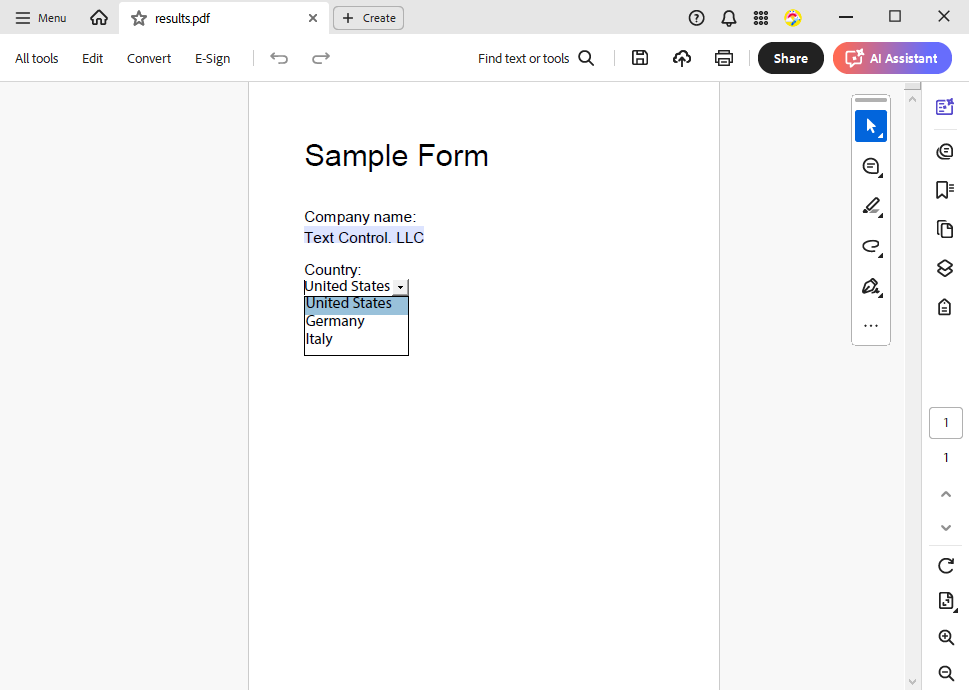
| Create a PDF Form | A PDF with a text box, a drop-down list and a check box to fill out, and the Form Fields tab of the ribbon | FormFields, TextFormField, SelectionFormField, CheckFormField |
| Digitally Sign a PDF | A PDF signed with a certificate, with a timestamp and a visible signature field | DigitalSignature, SaveSettings.DigitalSignature, SignatureField |
Before You Start
- Complete Create Your First WPF Application. Each tutorial adds buttons to its window, next to the
TextControlnamedtextControl1. - Check your edition. PDF is part of the Professional and Enterprise editions, PDF/A and form fields of the Enterprise edition. See Editions and Feature Availability.
The tutorials don't depend on each other, but the second and third use the Save call and the SaveSettings that Create a PDF introduces, so start with that one.
The Same API as in Other Applications
SaveSettings, the form field classes and DigitalSignature are shared by all TX Text Control .NET products, so the code of these tutorials also works with a ServerTextControl. WPF adds the XAML around it and a few types of its own: Save with a Save As dialog returns a DialogResult of the namespace TXTextControl.WPF, and the Form Fields tab is a RibbonFormFieldsTab in the Ribbon of WPF.