
PDF Forms
Registration forms, order forms and consent forms often travel as PDF documents that recipients fill in with a PDF reader and send back. With TX Text Control .NET for Windows Forms, the form starts as a document with form fields in the TextControl, becomes a fillable PDF when it is saved and returns as data your application reads. At the end, the values can be fixed in a flattened PDF for signing or archiving.
The first fillable PDF is built in Create a PDF Form in Getting Started. How users insert form fields with the ribbon is covered in Form Fields and Conditional Instructions, and the form field classes in Forms and Conditional Instructions. Form fields are part of the Enterprise edition, as Editions and Feature Availability lists.
How a PDF Form Travels
Design. A document gets form fields: text boxes, check boxes, drop-down lists, combo boxes and date fields, inserted in code, with the Form Fields tab of the ribbon or loaded from a Word form.
Create. Saved with
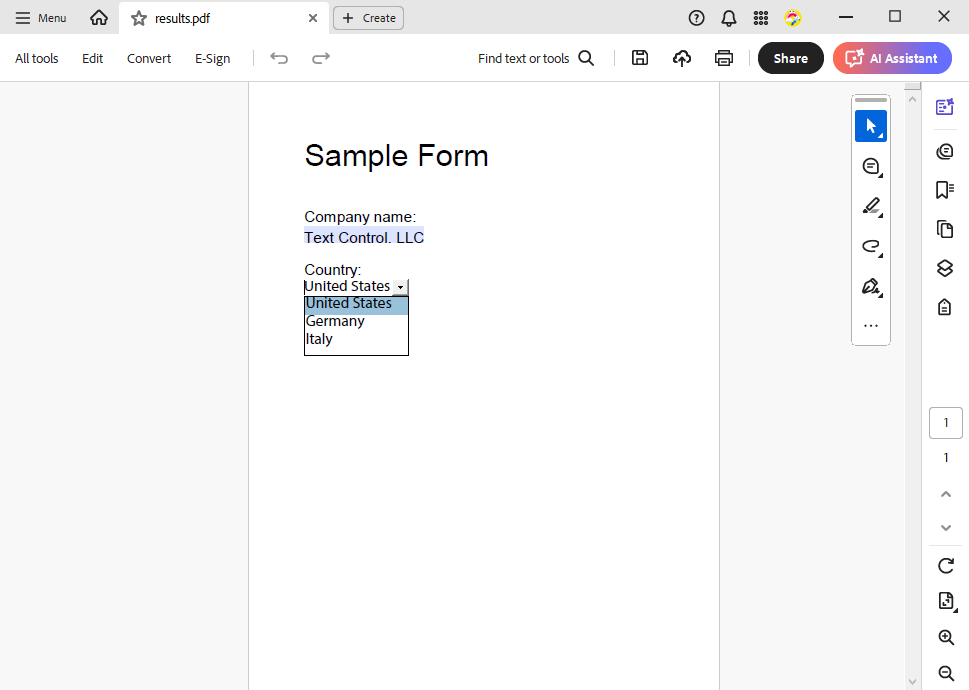
StreamType.AdobePDF, the form fields become AcroForm fields, the interactive fields of the PDF format, with their names and values.Fill in. Users fill in the form in Adobe Acrobat Reader, in Google Chrome or in another PDF reader:
Read.
Forms.GetAcroFormFieldsreturns the fields of the returned PDF with their values.Finalize. The values go back into your document of the form, the fields are flattened into text and the result is signed or archived.
TX Text Control reads the fields of an existing PDF but doesn't write values into it. A PDF with new or changed values is always saved from a document.
Find the Right Page
| If you want to | Read |
|---|---|
| Understand how form fields become PDF fields, convert a Word form and check the result | Creating AcroForms |
| Read the values of a filled PDF form and put them back into the editor | Reading Form Fields and Values |
| Protect a fillable form with permissions, or replace the fields with their values | Exporting Interactive and Flattened Forms |
| Fill in the form inside your own application | Let Users Fill Out the Form |
Where to Start
- Create a PDF Form, if you haven't saved a form as PDF yet.
- Creating AcroForms: what ends up in the PDF.
- Reading Form Fields and Values: get the data back.
- Exporting Interactive and Flattened Forms: finish the document.