
Timestamp Configuration
Why would a signature need a clock? Because years later, when the signer's certificate has expired, a reader of the document wants to know whether the certificate was valid at the moment of signing. The clock of the signing computer can't prove that: anybody can change it. A trusted timestamp from an RFC 3161 time server can. In a Windows Forms application, you configure it with a single parameter, the address of the time server, and TX Text Control requests the timestamp while it saves the signed PDF.
The shortest version, a timestamp for a whole-document signature, is part of Add a Trusted Timestamp in Getting Started. The sections below add what an application needs around it: fallback servers, a decision when no server answers and timestamps for signature fields.
Why a Signature Needs a Trusted Time
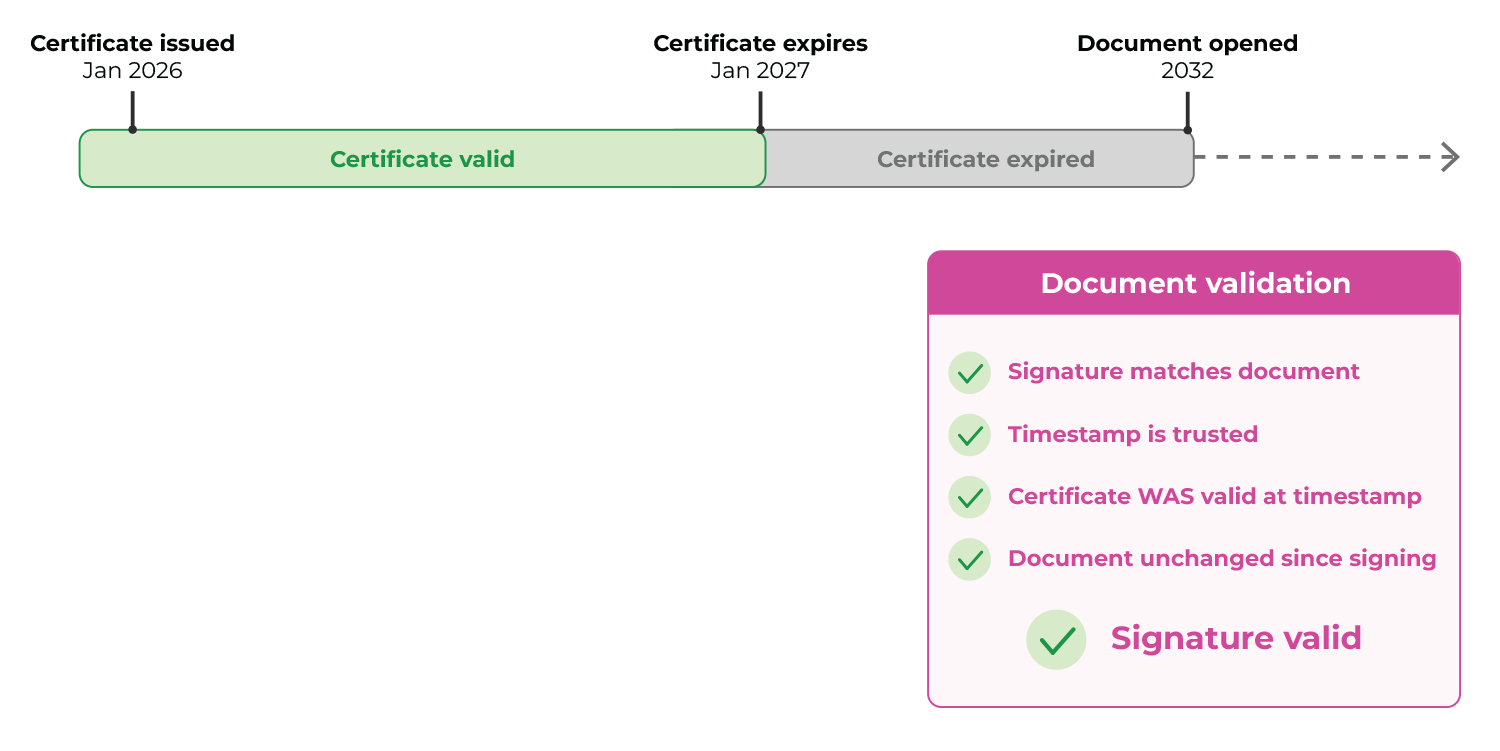
Suppose a contract is signed in February 2026 with a certificate that expires in January 2027, and somebody opens the contract in 2032. By then, a PDF reader knows only that the certificate has expired, not whether it was valid in February 2026. Without a trusted time, Adobe Acrobat and other validators often show warnings or state that the long-term validity of the signature can't be verified, although the document is unchanged.
With a trusted timestamp, the validator can confirm that the signature matches the document, that the timestamp is trusted, that the certificate was valid at the time of the timestamp and that the document hasn't changed since:
How a Timestamp Is Created
A time server, also called a Time-Stamping Authority (TSA), doesn't sign your document. When TX Text Control saves a signed PDF with a time server URL, these steps happen:
- TX Text Control creates the signature of the document.
- It sends a cryptographic hash of the signature to the time server. The PDF itself never leaves the computer.
- The time server combines the hash with the current, trusted UTC time and signs the result with its own certificate.
- TX Text Control embeds the returned timestamp token in the PDF as part of the signature.
For a desktop application, this means that the computer that signs needs a network connection to the time server at the moment of saving. The time server has no access to the document or its content.
Specify the Time Server
Both constructors of DigitalSignature take the URL of the time server as their second parameter, timeServerURL:
Value of timeServerURL | Signing time |
|---|---|
| An empty string | The current date and time of the computer |
The URL of an RFC 3161 time server, such as http://timestamp.digicert.com | A trusted timestamp from the time server |
Timestamps are offered by certificate authorities, and many organizations operate their own time servers for internal signing. Use a server that the readers of your documents trust, because validators check the timestamp as well.
DigitalSignature has no further settings for the time server, such as credentials, a proxy or a timeout. The server is contacted when Save creates the PDF, not when the DigitalSignature object is created.
Add Timestamps to Signature Fields
When signature fields are signed, each field gets its own DigitalSignature in SaveSettings.SignatureFields, and each of them has its own time server URL. To give every field a trusted timestamp, pass the URL instead of the empty string in the handler of Sign the Fields of the Document:
signatures.Add(new DigitalSignature(certificate, "http://timestamp.digicert.com", field.Name));
Each field then gets a timestamp of its own. Fields of one document can use different time servers, or none: Multiple Signatures signs one field with a timestamp and two without. The same InvalidTimeServer handling as above applies.
How Readers Show the Signing Time
Adobe Acrobat Reader lists each signature in its Signatures panel. For a signature without a timestamp, the panel says that the signing time is from the clock on the signer's computer:
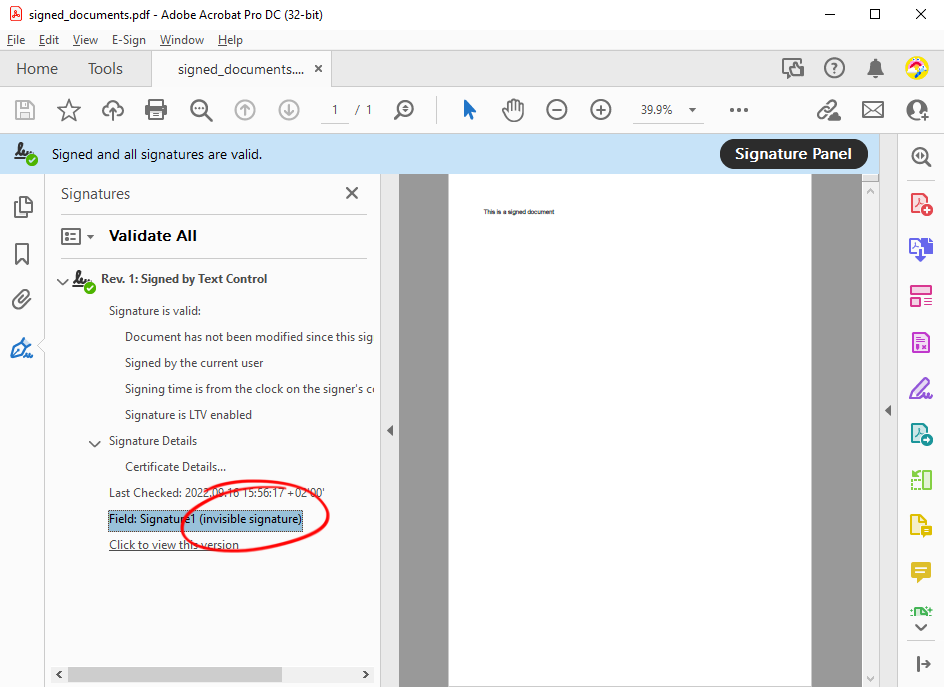
With a timestamp, the time is part of the signature as cryptographic evidence, so the signature can still be verified after the certificate has expired. The blog article Building Long-Term Trust with Digital Signatures and Timestamps in C# .NET explains the validation in more detail.
Timestamps and PAdES
Archives, contracts and regulations often ask for signatures by their PAdES profile, the PDF Advanced Electronic Signature profiles. Two of them differ only in the timestamp:
| PAdES-B | PAdES-T | |
|---|---|---|
| Contains | The digital signature, the signer's certificate and its certificate chain | Everything in PAdES-B and a trusted RFC 3161 timestamp |
| After the certificate expires or is revoked | A validator may not be able to tell whether the certificate was valid at signing time | The timestamp proves that the signature existed while the certificate was valid |
According to Text Control, a signature that TX Text Control creates with a certificate and the URL of a time server conforms to PAdES-T. The time server URL is the only choice you make: DigitalSignature has no members besides its constructors, so there is no setting for a profile, a hash algorithm or revocation data. When a recipient or a regulation requires a particular level, sign sample documents and check them with the validator the recipient uses before you rely on them. Verify the Signatures in Code shows what the TXTextControl.PDF.Validation package checks.
Next Steps
- Certificates: choose certificates that validators trust.
- Signature Fields and Signature Appearance: sign visible signature fields.
- Signing PDF Documents: handle certificate and time server errors when saving.