
Overview
Before you install a package or write code, the Overview gives you the big picture of TX Text Control .NET Server: what the product is and how it is built. Its pages are meant for .NET and web developers who have just bought the product or are evaluating it and haven't worked with TX Text Control yet.
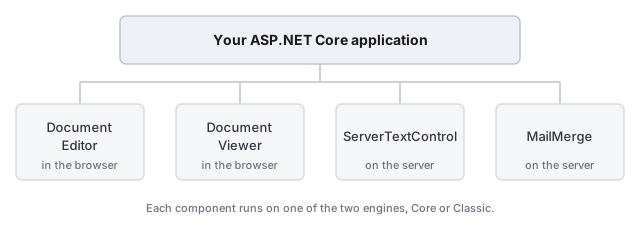
TX Text Control .NET Server is a set of components for document processing in .NET. You create, convert and change documents in code, merge data into templates, create PDF documents, and give your users a document editor or a document viewer in the browser. After reading this section, you know which components your application needs, which of the two engines to choose, where each part runs, and which platforms, file formats and licenses apply.
Find the Right Page
| If you want to | Read |
|---|---|
| Learn what the product does, what you can build with it and how it differs from other Text Control products | Introduction |
| Understand the Core and Classic engines, and how the Document Editor and Document Viewer connect to your ASP.NET Core application | Product Architecture |
Learn more about one component: the Document Editor, the Document Viewer, ServerTextControl or MailMerge | Components |
| Check operating systems, .NET versions, containers and cloud platforms | Supported Platforms |
| Check which document formats you can load and save | Supported File Formats |
| Understand developer licenses, runtime licenses, subscriptions and the trial version | Licensing Overview |
| Read the copyright and trademark notices | Legal Notice |
Where to Start
If you are new to TX Text Control, read the Introduction first and then Product Architecture. The two pages introduce the terms the rest of the documentation uses, such as Core, Classic, ServerTextControl and the Document Editor backend.
When you are ready to set up a project, continue with one of these sections:
- Installation Guide: system requirements, NuGet and npm packages, license configuration and upgrades.
- Getting Started: step-by-step tutorials that take you from an empty project to a running application.